The Music That Crosses Borders: How Sound Unites What Politics Divides
By the richyryanofficial.com Editorial Team
Introduction
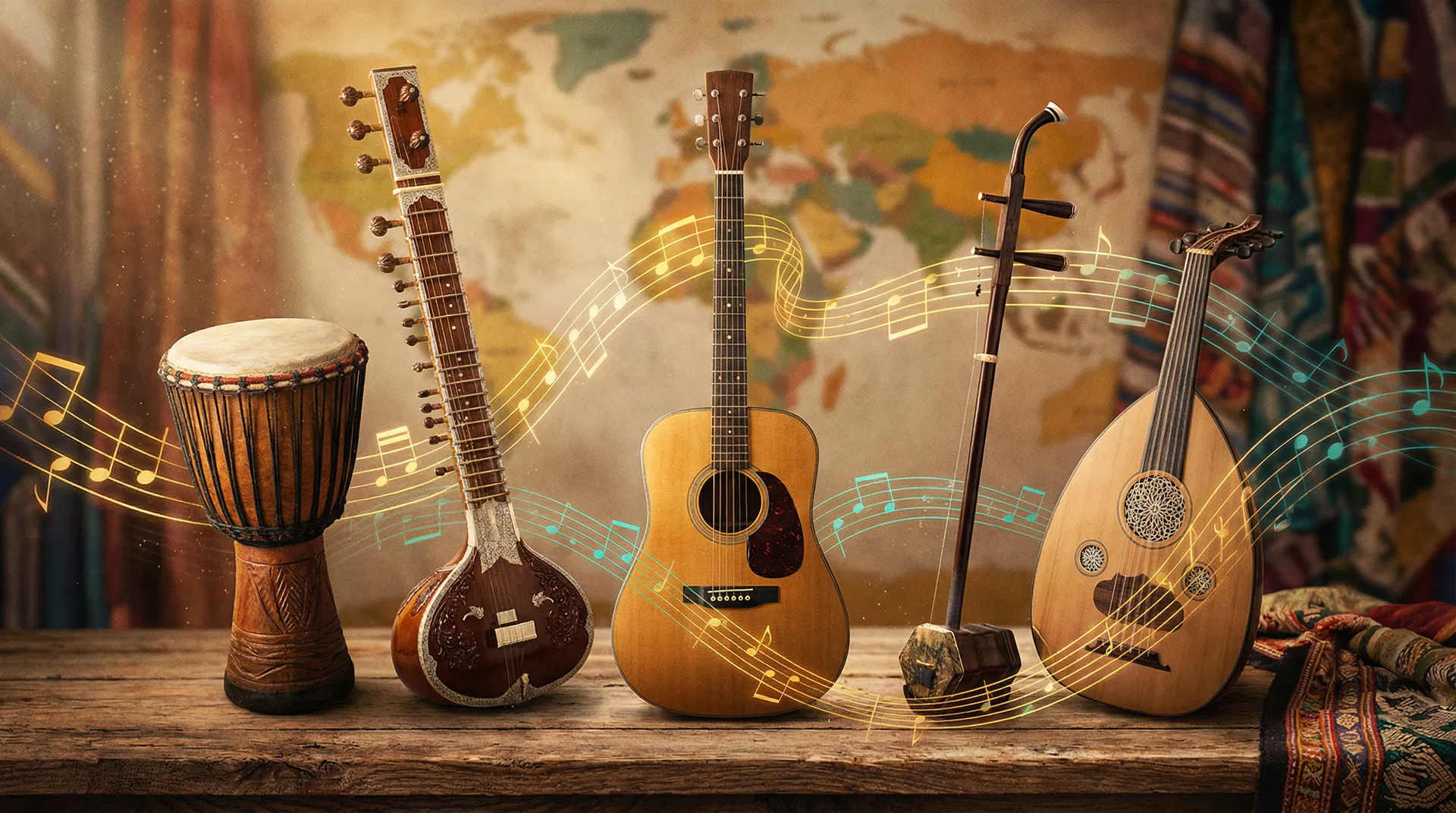
Music is a language that transcends words, a current that flows across borders, and a force that can unite where politics and conflict divide. Throughout human history, in times of profound division and in moments of quiet connection, sound has offered a bridge between disparate cultures and a powerful tool for peace. From the defiant anthems of social justice movements to the intricate harmonies of cross-cultural orchestras, music has consistently demonstrated its capacity to foster dialogue, empathy, and a sense of shared humanity. This article explores the multifaceted ways in which music has served as a unifying force, examining historical examples and the very neuroscience that explains its power to move us, together.
The Orchestra of Unity: The West-Eastern Divan
In 1999, against a backdrop of ongoing conflict and deep-seated animosity, a remarkable experiment in cultural diplomacy was born: the West-Eastern Divan Orchestra. Co-founded by the Israeli conductor and pianist Daniel Barenboim and the late Palestinian-American literary scholar Edward Said, the orchestra brings together young musicians from Israel, Palestine, and other Arab countries to perform and dialogue. The project was named after Johann Wolfgang von Goethe's collection of poems, the West-Eastern Divan, a work that itself sought to bridge the cultural divide between East and West [1].
The orchestra's mission extends far beyond musical performance. It is a space for human encounter, a platform for dialogue where young people who are officially enemies can meet on neutral ground and connect through the universal language of music. As Barenboim himself has stated, the Divan is not a peace-making project, but a 'project against ignorance.' It is a forum where the 'other' ceases to be an abstraction and becomes a fellow musician, a stand partner, a human being. The intensive summer workshops, where rehearsals are paired with discussions, create an environment where stereotypes can be challenged and mutual understanding can be fostered [2]. The orchestra has performed in concert halls around the world, from Ramallah to New York, serving as a powerful symbol of hope and a testament to the power of music to transcend political and cultural divides.
The Soundtrack of Freedom: Music in the Civil Rights Movement
Decades before the West-Eastern Divan Orchestra was conceived, music was already a powerful force for social change in the United States. The Civil Rights Movement of the 1950s and 1960s was propelled by a soundtrack of hope and defiance, a collection of spirituals, gospel, and folk songs that became known as "freedom songs." These were not mere entertainment; they were the organizational and emotional backbone of the movement.
Songs like "We Shall Overcome," which evolved from a 19th-century African-American gospel song, became the anthem of the movement, sung at marches, sit-ins, and in jail cells. It was a declaration of unity and resilience in the face of brutal opposition [3]. Other songs, like "This Little Light of Mine" and "Ain't Gonna Let Nobody Turn Me Around," were adapted and repurposed, their lyrics imbued with new meaning in the context of the struggle for equality. These songs served multiple purposes: they galvanized protestors, fostered a sense of community and shared purpose, and provided a powerful, non-violent response to oppression. As Martin Luther King, Jr. himself noted, "the freedom songs are the soul of the movement" [4]. They were a testament to the power of music to articulate a collective struggle and inspire a generation to demand justice.
Jazz Ambassadors: A Cold War Counter-Melody
During the ideological battle of the Cold War, the United States government deployed a secret weapon: jazz. In 1955, the State Department launched the Jazz Ambassadors program, sending some of America's most celebrated jazz musicians—including Duke Ellington, Louis Armstrong, and Dizzy Gillespie—on tours around the world, particularly to the Eastern Bloc and the Middle East. The program's goal was to counter Soviet propaganda that portrayed the United States as a culturally barren and racially unjust nation. Jazz, an art form born from the African-American experience, became a powerful symbol of American creativity, freedom, and cultural diversity [5].
The tours were a resounding success. Musicians like Willis Conover, whose Voice of America jazz program reached millions behind the Iron Curtain, became cultural icons. The music itself, with its improvisational spirit and emphasis on individual expression within a collective framework, was a potent metaphor for democracy. The Jazz Ambassadors program demonstrated that cultural diplomacy could be a powerful tool in international relations, winning hearts and minds in a way that political rhetoric could not. It was a testament to the idea that a nation's culture could be its most compelling ambassador [6].
The Global Cipher: Hip-Hop as a Voice for the Voiceless
In the latter half of the 20th century, a new musical form emerged from the marginalized communities of the South Bronx, a voice for the voiceless that would grow into a global phenomenon: hip-hop. Born from block parties and sound systems, hip-hop provided a powerful platform for young African-American and Latino artists to document their realities, protest social injustice, and forge a unique cultural identity. From its origins, hip-hop has been a tool for social commentary, a way to speak truth to power when other avenues are closed.
As hip-hop has spread across the globe, it has been adapted and remixed, a testament to its universal appeal and flexibility. From the favelas of Brazil to the banlieues of France, marginalized youth have adopted the rhythms and rhymes of hip-hop to tell their own stories of struggle and resilience. It has become a global language of protest, a unifying force for communities grappling with poverty, discrimination, and political oppression. The spread of hip-hop demonstrates how a musical form born from a specific cultural context can transcend its origins to become a powerful tool for empowerment and a symbol of solidarity for marginalized people everywhere [7].
The Neuroscience of Harmony: A Shared Human Experience
The power of music to unite us is not merely a cultural phenomenon; it is deeply rooted in our neurobiology. Recent research in neuroscience has begun to uncover the ways in which music activates shared emotional and physiological responses across cultures. A 2024 study published in Proceedings of the National Academy of Sciences found that music universally triggers similar bodily sensations in listeners, regardless of their cultural background. Sad music, for example, is consistently associated with a feeling of a lump in the throat, while danceable music elicits a desire to move [8].
These shared responses are linked to the brain's reward and empathy circuits. When we listen to music, our brains release dopamine, a neurotransmitter associated with pleasure and reward. This creates a sense of connection and shared experience, even with people we have never met. Furthermore, studies have shown that music can enhance empathy, activating the same brain regions that are involved in understanding the emotions of others. When we listen to a piece of music that expresses a particular emotion, our brains mirror that emotion, allowing us to feel what the composer and performers are feeling. This neural resonance is a powerful force for connection, allowing us to bridge cultural divides and experience a sense of shared humanity on a fundamental, biological level.
Conclusion: The Unending Dialogue
From the concert halls of the West-Eastern Divan to the streets of the South Bronx, music has consistently proven its ability to build bridges where politics has built walls. It is a testament to the enduring power of human creativity and our innate desire for connection. The examples explored in this article are but a few of the countless instances where music has served as a catalyst for dialogue, a source of solace, and a symbol of hope. In a world that often seems fractured and divided, music reminds us of our shared humanity. It is a conversation that never ends, a melody that crosses every border, and a rhythm that beats in every human heart. It is, and always has been, a powerful force for peace, love, and human connection.
Citations
[1] "West–Eastern Divan Orchestra." Wikipedia, Wikimedia Foundation, 20 Oct. 2023, en.wikipedia.org/wiki/West%E2%80%93Eastern_Divan_Orchestra.
[2] "The Founders." West-Eastern Divan Orchestra, west-eastern-divan.org/founders.
[3] "Music in the Civil Rights Movement." American Experience, PBS, www.pbs.org/wgbh/americanexperience/features/eyesontheprize-music-civil-rights-movement/.
[4] "Songs and the Civil Rights Movement." The Martin Luther King, Jr., Research and Education Institute, kinginstitute.stanford.edu/songs-and-civil-rights-movement.
[5] Waxman, Olivia B. "How the U.S. Used Jazz as a Cold War Secret Weapon." Time, Time, 6 Dec. 2017, time.com/5056351/cold-war-jazz-ambassadors/.
[6] Breckenridge, Matthew A. "Willis Conover's International Jazz Diplomacy: A Case Study of the Cold War, Modernism, and Globalization." Jazz Perspectives, vol. 8, no. 1, 2014, pp. 1–27., doi:10.1080/17494060.2014.884204.
[7] "Hip-Hop at 50: Global Culture, Global Voices." College of Humanities, University of Arizona, 9 Nov. 2023, humanities.arizona.edu/news/hip-hop-50-global-culture-global-voices.
[8] Putkinen, V., et al. "Bodily maps of musical sensations across cultures." Proceedings of the National Academy of Sciences, vol. 121, no. 6, 2024, e2308859121.
© 2026 richyryanofficial.com — All perspectives are valued.