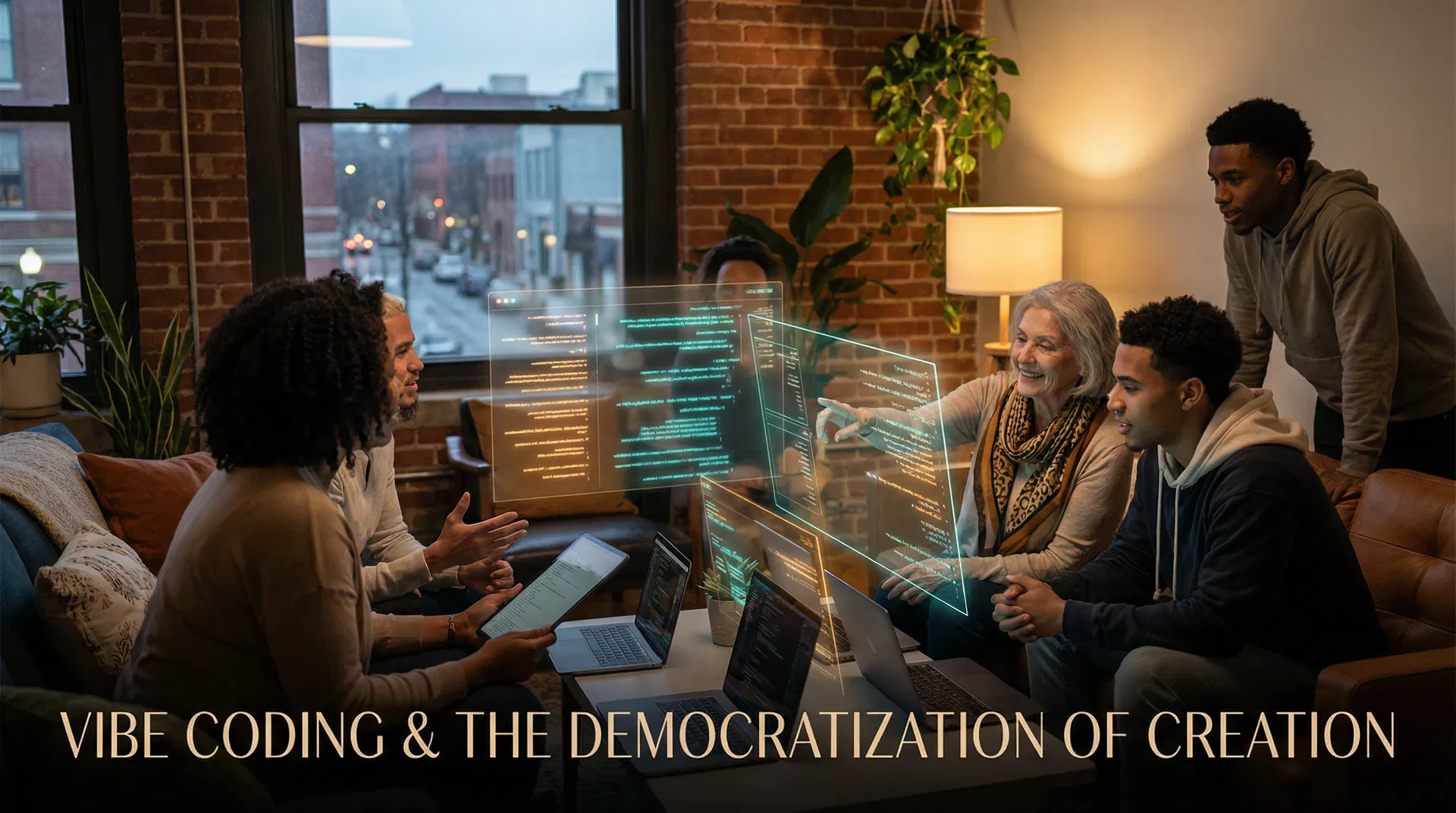
Vibe Coding and the Democratization of Creation: Why Everyone Is a Builder Now
By richyryanofficial.com Editorial Team Section: Technology & Vibe Coding Format: Long Form (~1800 words)
Introduction
For generations, the act of creation in the digital world was gated by a formidable barrier: the esoteric language of code. To build an app, a website, or a piece of software, one had to first become fluent in the logic of machines, a journey requiring years of dedicated study and practice. This reality created a clear division between the architects of the digital realm and its inhabitants. But what if that barrier is beginning to dissolve? We are entering a new era of creation, one defined not by rigid syntax and complex algorithms, but by intuition, intention, and conversation. This is the age of vibe coding, a revolutionary approach where software is built by describing what you want in natural language, and artificial intelligence translates those desires into functional code. This emerging phenomenon is more than just a new set of tools; it represents a profound democratization of creation, empowering a new generation of builders who were previously excluded from the conversation. It raises fundamental questions about the nature of creativity, the future of work, and the very definition of what it means to be a builder in the 21st century. As we stand at this inflection point, it is crucial to explore both the immense promise and the potential perils of a world where anyone, regardless of technical expertise, can bring their digital ideas to life.
The Dawn of Conversational Creation
The rise of vibe coding is not a sudden revolution but an evolution, built upon decades of progress in artificial intelligence and user interface design. At its core, this new paradigm is powered by a confluence of technologies that are making software development more accessible and intuitive. The most prominent of these are AI code assistants, which have rapidly moved from experimental tools to indispensable partners for developers. Platforms like GitHub Copilot, integrated directly into a programmer's workflow, can suggest lines of code, complete functions, and even generate entire code blocks from a simple natural language prompt. This not only accelerates the development process but also lowers the barrier to entry for those who are still learning the intricacies of a programming language [1].
Beyond assisting professional developers, a new wave of no-code and low-code platforms has emerged, empowering individuals with no prior coding experience to build sophisticated applications. Services like Bubble and Webflow allow users to design and build web applications using visual interfaces, dragging and dropping elements to create complex workflows and user experiences. While these platforms have existed for some time, their integration with generative AI has supercharged their capabilities, allowing users to generate application components, design elements, and even backend logic through simple text descriptions. This shift from visual programming to conversational creation is a key tenet of the vibe coding philosophy, where the user's intent is the primary input.
Finally, the advent of powerful large language models (LLMs) like OpenAI's GPT series and Google's Gemini has been the catalyst for the most ambitious forms of vibe coding. These models are capable of understanding and generating human-like text, and when trained on vast datasets of code, they can translate natural language descriptions into functional software. This has given rise to a new category of tools that aim to make software development as simple as having a conversation. Platforms like Replit have integrated AI features that allow users to build and deploy applications from a single prompt, blurring the lines between idea and execution [2]. As these technologies continue to mature, the process of creating software will likely become even more conversational, further democratizing the ability to build in the digital world.
The New Faces of Creation
The most profound impact of vibe coding is its radical democratization of who gets to be a builder. For decades, the digital landscape was constructed by a specialized class of software engineers and programmers. This created a bottleneck, where great ideas often languished due to a lack of technical resources or the high cost of hiring developers. Vibe coding, along with the broader no-code/low-code movement, is dismantling this exclusivity, giving rise to a new class of creators: citizen developers [3]. These are individuals who have deep domain expertise in their respective fields—be it marketing, finance, education, or art—but lack formal programming skills. Empowered by intuitive, AI-driven tools, they can now build the software they need to solve their own problems and bring their unique visions to life.
This shift is not just about making it easier for more people to code; it's about enabling a more diverse range of perspectives to shape the digital world. A 2025 report from Gartner predicted that by 2028, over 70% of new applications developed by enterprises will use low-code or no-code technologies, up from less than 25% in 2023 [4]. This surge is being driven by the recognition that the people closest to a problem are often the best equipped to solve it. A teacher can now build an interactive learning app for their students, a small business owner can create a custom e-commerce platform, and an artist can design an immersive digital experience, all without writing a single line of code. This not only accelerates innovation but also leads to more relevant and user-centric products.
The democratization of creation also has significant implications for entrepreneurship. The ability to quickly and inexpensively build a minimum viable product (MVP) is a game-changer for startups. Entrepreneurs can now test their ideas in the market, gather feedback, and iterate on their products without the need for significant upfront investment in a technical team. This levels the playing field, allowing a more diverse group of founders to compete with established players. As Andrej Karpathy, the computer scientist who coined the term "vibe coding," has noted, this new paradigm allows for a more fluid and intuitive approach to creation, where the focus is on the "vibe" of the product rather than the technical implementation details [5]. This shift in mindset is empowering a new generation of builders to think more creatively and ambitiously about what is possible.
The Ghost in the Machine: Redefining Creativity and Work
The rise of vibe coding is not without its philosophical complexities. As we delegate more of the creative process to intelligent machines, we are forced to confront fundamental questions about the nature of creativity, the value of human labor, and the future of work itself. Enthusiasts argue that these tools are not a replacement for human creativity but an augmentation of it, a new kind of instrument that allows us to express our ideas more fluidly and ambitiously. In this view, the AI is a collaborator, a partner that can handle the tedious and technical aspects of creation, freeing up the human to focus on the higher-level vision and intent. The artist, in this model, becomes a conductor, orchestrating the creative output of the machine to achieve a result that would have been impossible to create alone [6].
However, this optimistic view is not universally shared. Skeptics raise concerns about the potential for these tools to devalue the skills and expertise that have traditionally been associated with creative professions. If anyone can generate a beautiful piece of art or a functional piece of software with a simple text prompt, what does that mean for the livelihoods of artists and programmers who have spent years honing their craft? This is not just a question of economics; it is a question of meaning and purpose. For many, the process of creation is as important as the final product, a journey of struggle, discovery, and personal growth. The fear is that by outsourcing this process to a machine, we risk losing something essential about what it means to be human [7].
Furthermore, there are complex ethical questions surrounding the ownership and authorship of AI-generated content. If a work is created through a collaboration between a human and an AI, who is the author? Who owns the copyright? These are not just legal questions; they are philosophical ones that challenge our traditional notions of creativity and originality. As we move forward, it will be crucial to engage in a thoughtful and inclusive dialogue about these issues, ensuring that the benefits of this new technology are shared broadly and that we do not inadvertently devalue the human element in the creative process. The goal should not be to replace human creativity but to augment it, to create a future where humans and machines can collaborate to achieve new heights of innovation and artistic expression.
Conclusion: A New Dialogue Between Creator and Creation
The emergence of vibe coding represents a pivotal moment in our relationship with technology and creativity. It is a powerful force for democratization, breaking down the barriers that have long separated the creators of our digital world from its inhabitants. This new paradigm has the potential to unleash a wave of innovation, empowering a more diverse range of voices to shape the future of software and art. However, it also presents us with a series of profound philosophical and ethical challenges that we must navigate with care and foresight. The path forward is not to reject these new tools but to engage with them in a spirit of critical inquiry and thoughtful dialogue.
As we continue to explore the possibilities of vibe coding, it is essential that we foster a conversation that includes not just technologists and entrepreneurs but also artists, educators, ethicists, and policymakers. We must work together to create a future where these powerful new technologies are used to augment human creativity, not replace it; to empower individuals, not devalue their skills; and to create a more inclusive and equitable digital world. The journey ahead will be complex and at times uncertain, but it is a conversation worth having. By embracing the spirit of dialogue and understanding, we can ensure that the democratization of creation is a force for good, enriching our lives and expanding our collective human potential.
Citations
- Harkar, S. (2025, February). What is Vibe Coding? IBM.
- Mehta, I. (2025, March 6). A quarter of startups in YC’s current cohort have codebases that are almost entirely AI- based generated. TechCrunch.
- van der Meulen, R., & Rivera, J. (2023, April 26). Gartner Says 70% of New Applications Developed by Enterprises Will Use Low-Code or No-Code Technologies by 2025. Gartner.
- Karpathy, A. [@karpathy]. (2025, February 21). There's a new kind of coding I call "vibe coding", where you fully give in to the vibes, embrace exponentials, and forget that the code even exists [Tweet]. X. https://x.com/karpathy/status/1886192184808149383
- Wu, J. (2025, April 10). Artificial Intelligence and the Creative Double Bind. Harvard Law Review.
- Evans, A. (2023, February 24). The Ethics of AI Art. Center for Media Engagement.
- Wardzinski, T. (2026, February 17). The uncomfortable truth about vibe coding. Red Hat Developer.
© 2026 richyryanofficial.com — All perspectives are valued.